




When carbon Fiber meets the How Five-axis Machining Centers Disrupt Modern Industry.
When carbon Fiber meets the How Five-axis Machining Centers Disrupt Modern Industry.
Release date :2025-07-12 Browse times:321
Precision, dust-free, and complex curved surfaces formed in one go, this "industrial scalpel" is cutting through the future. Carbon fiber, the "black gold" that is four-fifths lighter than steel but five times stronger, has become the darling of high-end manufacturing. From the speeding high-speed trains to the soaring drones, from the hundred-meter-long wind turbine blades to the carbon fiber subways shuttling underground, its presence is everywhere.
However, when it comes to precisely shaping this hard yet fragile material, traditional machine tools are at a loss - severe tool wear, the risk of dust explosion, delamination and cracking, each of these challenges is enough to keep engineers awake all night.
01 Carbon Fiber: The "Sword" and "Shield" of Industrial Materials
The charm of carbon fiber lies in its almost contradictory combination of properties. Its density is only one fourth that of steel, yet its tensile strength is up to six times that of steel, and its elastic modulus is more than twice that of steel. What's even more astonishing is that it does not deform at high temperatures, does not corrode in corrosive environments, and possesses excellent fatigue resistance.
It is precisely these characteristics that make it the preferred material for scenarios that require both lightweighting and high strength, such as the bodies of high-speed trains, the wings of aircraft, and the propellers of unmanned aerial vehicles. Take the world's first commercial carbon fiber train of Qingdao Metro, "Cetrovo 1.0 Carbon Star Express Rail", as an example. The entire vehicle weighs 11% less, energy consumption is reduced by 7%, and each train can annually reduce 130 tons of carbon dioxide emissions.
However, the "stubbornness" of carbon fiber becomes evident during the processing. Its extremely high hardness causes the cutting tools to behave like sandpaper, resulting in a wear rate that is more than five times higher than that of metal processing; the micro-sized dust generated during cutting not only poses a threat to the workers' respiratory systems but also has the risk of explosion; and the fragile interlayer bonding force makes edge cracking a common occurrence.
02 War God Five-axis: Solving the Problem of Carbon Fiber Processing
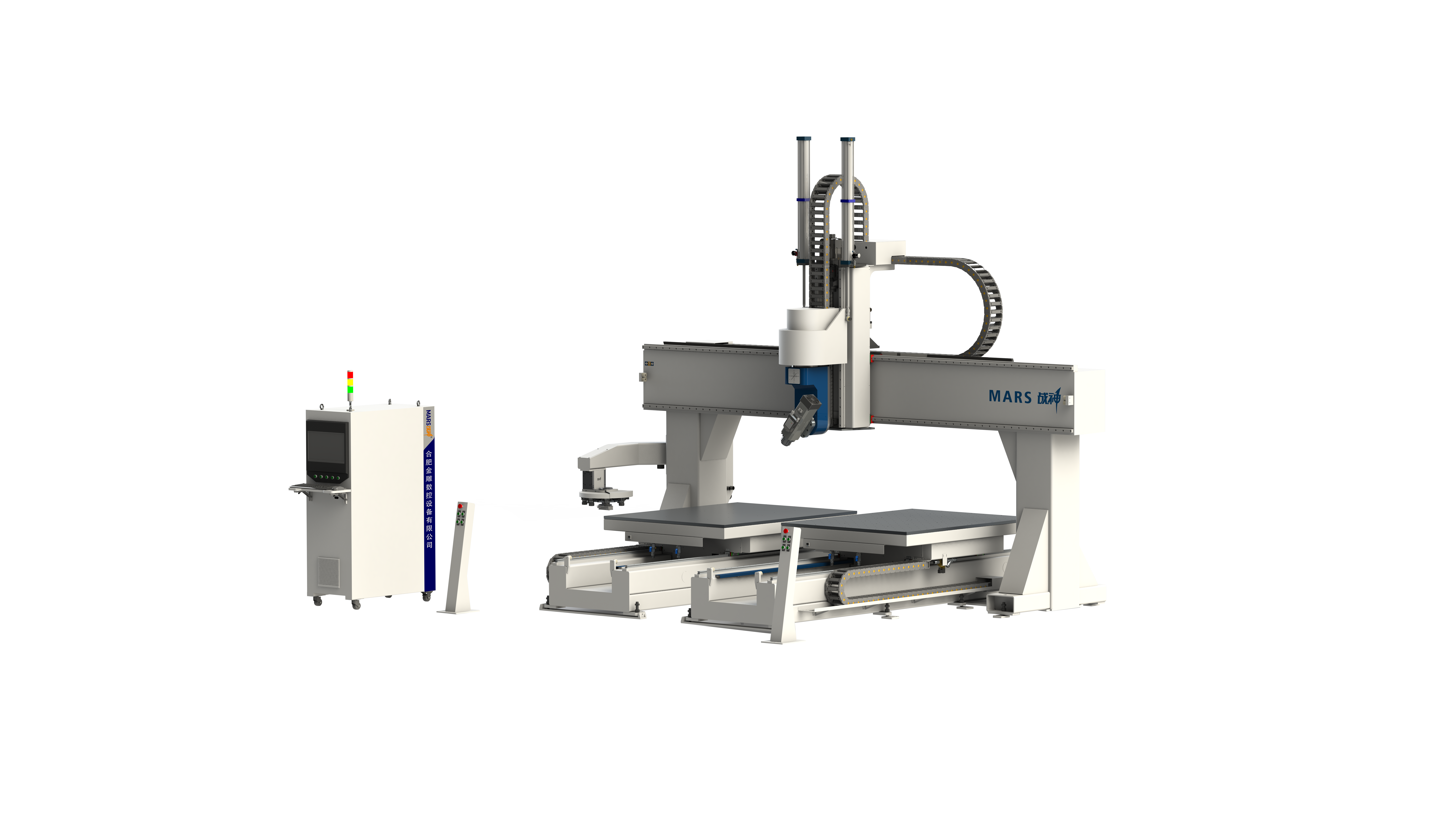
In the face of the processing challenges of carbon fiber, the War God five-axis machining center has provided a systematic solution. The core lies in the five-axis coordinated control technology - through the coordinated movement of the X/Y/Z linear axes and the A/C rotating axes, it enables processing at any angle in space, completely solving the problems of complex curved surface processing.
Take the processing of high-speed rail carbon fiber skirt panels as an example. The Zeus model demonstrates three major technological breakthroughs: High-speed electric spindle: A rotational speed of 20,000 revolutions per minute combined with a liquid constant-temperature cooling system ensures smooth and hairless fiber cutting edges without burrs, avoiding layering; Intelligent RTCP function: Real-time compensation of the tool tip trajectory, even if the spindle swings and tilts, the tool tip still precisely follows the programmed path, controlling the surface processing error within ±0.05mm; Dual workstation design: Processing in Area A while loading in Area B, combined with an automatic tool setter, increases equipment utilization by 70%. The most revolutionary innovation lies in the dual dust prevention system: A fully enclosed processing cabin equipped with a negative pressure dust collection system can capture 99% of the dust; The spindle end is further integrated with a following high-vacuum suction nozzle, which follows the cutting point in real time as the tool angle changes, like giving the tool tip a "dust mask". This system reduces the PM2.5 concentration in the workshop by 90%, completely solving the "invisible killer" of carbon fiber processing.
03 Industrial Revolution: The Practical Legend of Carbon Fiber and Five-Axis联动 Technology
In the field of rail transportation, after the CR450 high-speed train body was made of carbon fiber composite materials, extremely strict requirements were imposed on the processing accuracy.
In the aerospace industry, the processing of the carbon fiber fuselage framework of aircraft is a test of the limits of equipment.
The drone industry has undergone a qualitative change due to five-axis machining. The traditional aluminum alloy landing gear requires the assembly of over 20 parts, while the War God five-axis center uses carbon fiber integrated molding technology to reduce the number of parts by 60% and the weight by 45%.
04 Future Battlefields: When the Five-Axis Center Also "Wears" Carbon Fiber
Frontier technologies are ushering in a new era for carbon fiber processing. The new generation of the "War God" model integrates the intelligent ecosystem of the Internet of Things: the digital twin platform: pre-process the processing procedure in the virtual space, with collision warning accuracy reaching 0.01mm, and reducing the trial-and-error cost by 90%; the adaptive cutting system: adjusts the feed speed in real time through vibration sensors, extending the tool life by 40%; the modular spindle: enables quick replacement of the electric spindle head, allowing for mixed processing of carbon fiber, fiberglass, and even titanium alloys. What is even more disruptive is the evolution of the machine tool itself. Japanese companies such as OKUMA and Fanuc are collaborating with research institutions to apply carbon fiber composite materials to the moving parts of five-axis centers. The gantry frame made of CFRP weighs 30% less, with a thermal expansion coefficient only one-tenth that of metal, reducing the machine tool's energy consumption by 20% and improving the precision stability by 35% - processing equipment begins to "enjoy" its own processing results.
When the tip of the "War God"'s knife touches the carbon fiber, the boundary of industrial civilization is rewritten once again. (The article is sourced from AI and is for reference only.)