




The Precision Scalpel of Glass Fiber: How does the God of War Five-axis Machining Center
The Precision Scalpel of Glass Fiber: How does the God of War Five-axis Machining Center
Release date :2025-07-12 Browse times:232
At the wind farm, a hundred-meter-long blade pierces through the air. On the luxury yacht, the streamlined hull cuts through the waves. In the new type of passenger aircraft, lightweight components soar to the sky - the core of these cutting-edge products all cannot do without a magical material: glass fiber (also known as fiberglass reinforced plastic). As a "versatile player" among composite materials, glass fiber has become a new favorite in high-end manufacturing due to its light weight, high strength, corrosion resistance, and excellent insulation.
However, the processing of this material once gave engineers a headache!
01 Why does glass fiber leave traditional processing at a loss?
Glass fiber is not a "mild" material. It is made of a combination of glass fiber and resin, featuring extremely high hardness and wear resistance. At the same time, it also has anisotropy - the mechanical properties vary significantly in different directions. These characteristics bring about three major processing challenges: Severe tool wear: The hardness of glass fiber far exceeds that of ordinary metals. During processing, it is like cutting sandpaper with a knife, and the tool is prone to wear and scrapping. Dust is fraught with danger: The micron-level dust generated during cutting not only pollutes the environment but also damages workers' respiratory systems and even poses an explosion risk. Prone to delamination and cracking: The interlayer bonding force of the material is limited. Improper cutting force can cause edge cracking and internal delamination of the material, resulting in the direct scrapping of the finished product.
Traditional three-axis machine tools are even more powerless when dealing with complex curved surfaces. The production of a wind turbine blade mold often requires dozens of re-clamping operations, with cumulative precision errors reaching the millimeter level. However, the assembly accuracy of the blade root must be within ±0.2mm; otherwise, it will directly affect the power generation efficiency.
02 Five-axis Linkage: How to Resolve the Dilemma in Glass Fiber Processing?
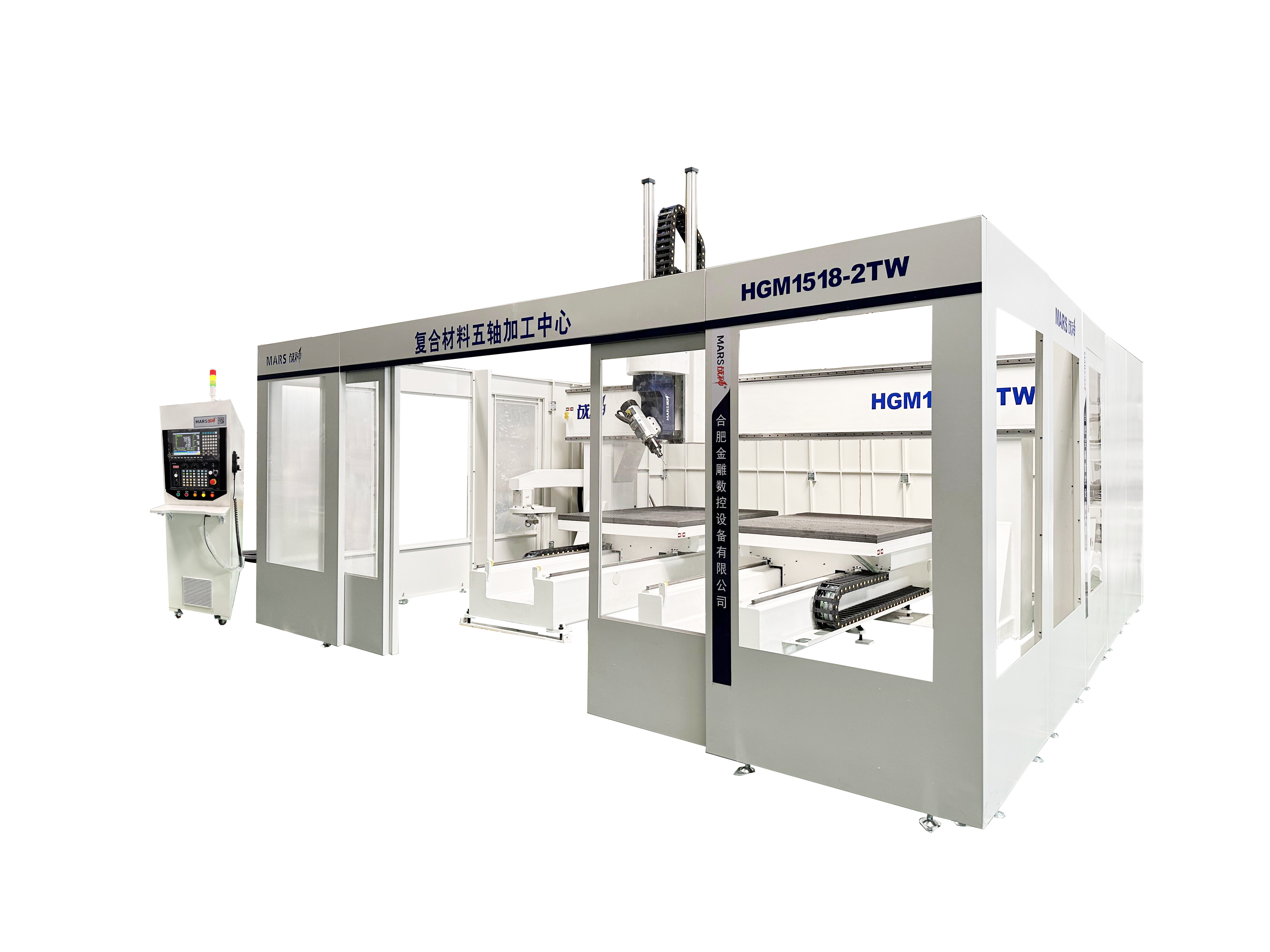
The emergence of the God of War five-axis machining center has provided a systematic solution to this predicament. The core technology lies in five-axis linkage control: in addition to the three linear axes of X/Y/Z, two rotational axes (usually A/C axes) are added to achieve processing at any Angle in space.
Take the Shenshen Bridge type model as an example. Its technical breakthrough point lies in: high-rigidity gantry structure: dual motor-driven gantry frame, combined with widened linear guide rails, ensuring uniform distribution of cutting force and avoiding material vibration cracking. Intelligent RTCP function: Real-time compensation for the tool tip point trajectory. Even if the rotation axis swings, the tool tip always precisely follows the programmed path, solving the problem of surface processing errors. 20,000 RPM high-speed electric spindle: Ceramic bearings and liquid constant temperature system support continuous operation, ensuring smooth and burr-free fiber cuts. Even more revolutionary is the powder