




MARS CNC reciprocating panel saw Automation of low value-added processes
MARS CNC reciprocating panel saw Automation of low value-added processes
Release date :2025-07-21 Browse times:191
Does your factory encounter phenomena such as chipping, surface tearing, and edge burrs when cutting fiberglass boards?
Try the War God reciprocating panel saw, which is specially developed for fiberglass materials
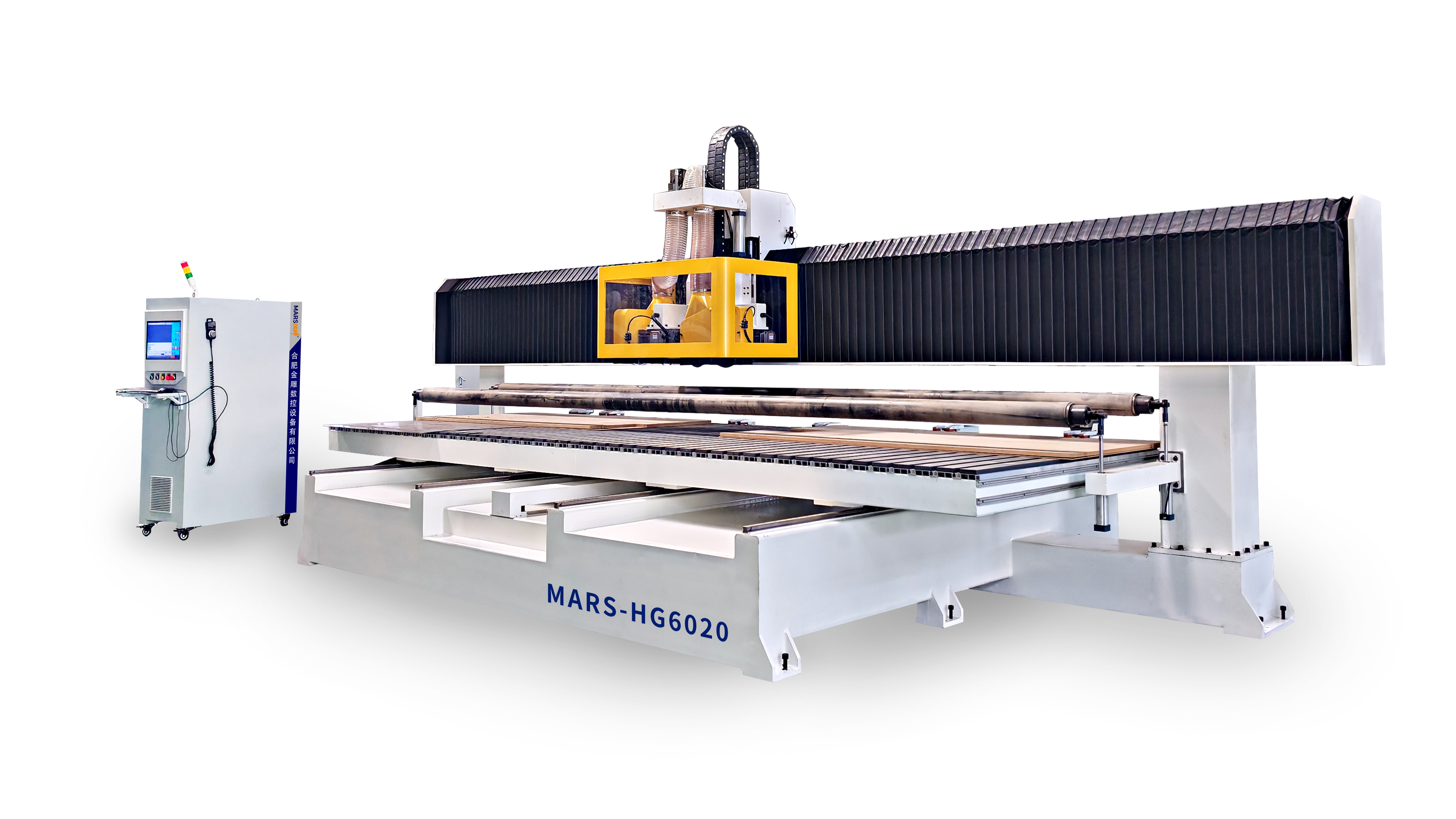
Anti-cracking edge, enhancing cutting quality
Pre-cutting of sub-saw (auxiliary saw): The sub-saw makes a narrow groove at the front end (usually 0.1 - 0.3mm thinner than the main saw blade). Then, the main saw follows the pre-cut groove to complete the cutting, preventing the lower surface of the board from chipping (especially suitable for materials prone to chipping such as laminated panels and melamine boards).
Main saw precise cutting: The main saw is responsible for the final dimensions, ensuring a smooth and edge-free finish with no burrs, thereby reducing the need for subsequent sanding processes.
2. High efficiency and flexibility
Dual saws working together: The master saw and the slave saw can work simultaneously, reducing the time for changing blades or adjustments. For instance, after the sub-saw performs the preliminary cutting, the main saw then proceeds with the fine cutting, eliminating the need for repositioning, and the efficiency is increased by over 30% compared to using a single saw.
Composite processing: Some models support the separate operation of the sub-saw (such as cutting small grooves and trimming edges), while the main saw is used for large-scale cutting. This allows for multiple functions from a single machine, thereby reducing equipment costs.
3. Extend the lifespan of the cutting tool
Sharing the cutting load: The sub-saw cuts the surface layer first, reducing the cutting resistance of the main saw, lowering the wear of the main saw, and extending the service life of the saw blade (especially effective for high-hardness materials such as fireproof boards and particle boards).
4. Adapt to complex processes
Multi-thickness compatibility: The sub-saw height is adjustable, capable of accommodating different board thicknesses (such as 5-50mm). The main saw is responsible for the final depth, avoiding vibration or deformation caused by a single deep cut.
5. Advantages of Automated Integration
CNC linkage: In a machining center, the sub-saw can be linked with the CNC system. Through program control, the pre-cutting depth of the sub-saw and the path of the main saw can be determined, enabling high-precision batch processing (such as the one-time completion of material cutting and slotting for custom furniture).
Reduce human intervention: Automatically adjust the spacing and speed of the saw blades, lower the operational threshold, and be suitable for unmanned production lines.
Typical application scenario for panel furniture: Cutting of the panels for cabinets and wardrobes to prevent exposed edges after edge sealing.
Wood door processing: Slotting and edge trimming of the door core board, ensuring that the assembly gaps are tight.
Composite materials: Precise cutting of aluminum-plastic panels and carbon fiber panels to avoid delamination.
Notes for Attention
Cost consideration: The parent-child sawing system is 20% to 30% more expensive than the ordinary sawing set, but it saves costs on tools and rework in the long run.
Maintenance requirements: It is necessary to regularly check the concentricity between the sub-saw and the main saw to prevent the deviation of the pre-cutting groove from causing a decrease in accuracy.
Conclusion:
The mother-and-son saw achieves superior performance in terms of anti-cracking edges, efficiency and lifespan through the division of labor between "pre-cutting" and "finishing-cutting". It is particularly suitable for large-scale production where strict edge quality is required.
(The article is sourced from AI and is for reference only.)